Wednesday, April 24, 2013

Scissors Crossing to Warner Springs, April 14th-16th


A collection of thru-hikers and section hikers were clustered under the bridge, sharing stories.  I chatted and joked with them a little, but was ready to start my hike.  A pair of guys with sun hats and trekking poles showed up and took off again quickly; I started out shortly after them, and caught up after a half-hour.  They introduced themselves as Kobe Cache and Afghani Danny, and they had me laughing within minutes.  Kobe was a volleyball coach and was taking time off to thru-hike.  Afghani was only hiking the first 100 miles before returning to San Diego for the busiest part of the landscaping season.  He planned to work for the first half of the summer and then to travel and play for the second half.  His other source of income was the ownership of several cash machines in bars, and he was currently in the process of entrusting a friend with the task of carrying the large amounts of cash to the machines to stock them.  

The boys quickly realized that they could act like boys around me, and within an hour they had me laughing so hard my stomach hurt.  They only met the previous week on the trail, but somehow clicked in a way that each brought out the hilarity in the other.  They even had the same favorite movie, called Super Troopers, and constantly quoted lines from it, their favorite of which was

You boys like Me-hi-co?  

At one point I stopped to pee and rearrange some things in my pack and they got a ways ahead of me.  Wanting to get back into the zone of laughter I literally jogged to catch up with them.  I found that I could actually jog with my pack on, although it probably didn’t do any favors for my knees.  


 As we laughed and climbed the winds climbed as well, and by the time dusk approached it was literally howling.  We came to a site out of the wind with space for only one tent.  My Guthook’s app showed another site a half-mile out, but when we arrived it was on a ridge, the wind screaming across it.  The next campsite another half-mile on was the same, the trees visible in Guthook’s campsite photo having been burnt in a recent fire.  The next spot was in a sort of small canyon below the trail, and initially seemed perfect.  The wind blew down intermittently, but there was plenty of space for tents and even a campfire.  As we pitched our tents the gusts grew in intensity.  Kobe put large rocks on top of his tent stakes, and across one of mine as a helpful gesture.  Afghani made a fire and we sat around it to cook dinner.  I was absorbed in Kobe’s alcohol stove, wondering if its extreme light weight and ability to cook things slowly might make it preferable to my JetBoil.  I heard a slight clinking noise in the distance, but didn’t pay it any attention. 

“Did you hear a metallic noise?”  Afghani asked.  Kobe nodded and they both jumped up and charged off.  I followed them, and saw that the wind had ripped up all of my tent stakes, flinging them out in all directions where I would find them the next morning, and that my entire tent with my sleeping pad and bag inside it was airborne, anchored only by the line leading to the spike that Kobe had covered with a large rock.  The boys wrestled the tent to the ground and Afghani held it and helped me untwist the components while Kobe ran off to fetch more rocks.  We re-pitched it in the lee of Kobe’s tent, anchored by an abundance of large rocks, and returned to the campfire.

“What would I have done without you guys?  My tent would have been over that cliff.”  They laughed.

“Without us, you would have just pitched your tent and crawled into it.”  Still, I was incredibly grateful to have encountered my first night of tricky conditions in the company of two experienced outdoorsmen.  

Danny trying to get out of his tent in the morning

The boys doing their morning calisthenics
 In the morning I made coffee, and somehow managed to find all seven of my tent stakes.  Kobe took off ahead and Afghani and I leapfrogged each other for most of the day.   
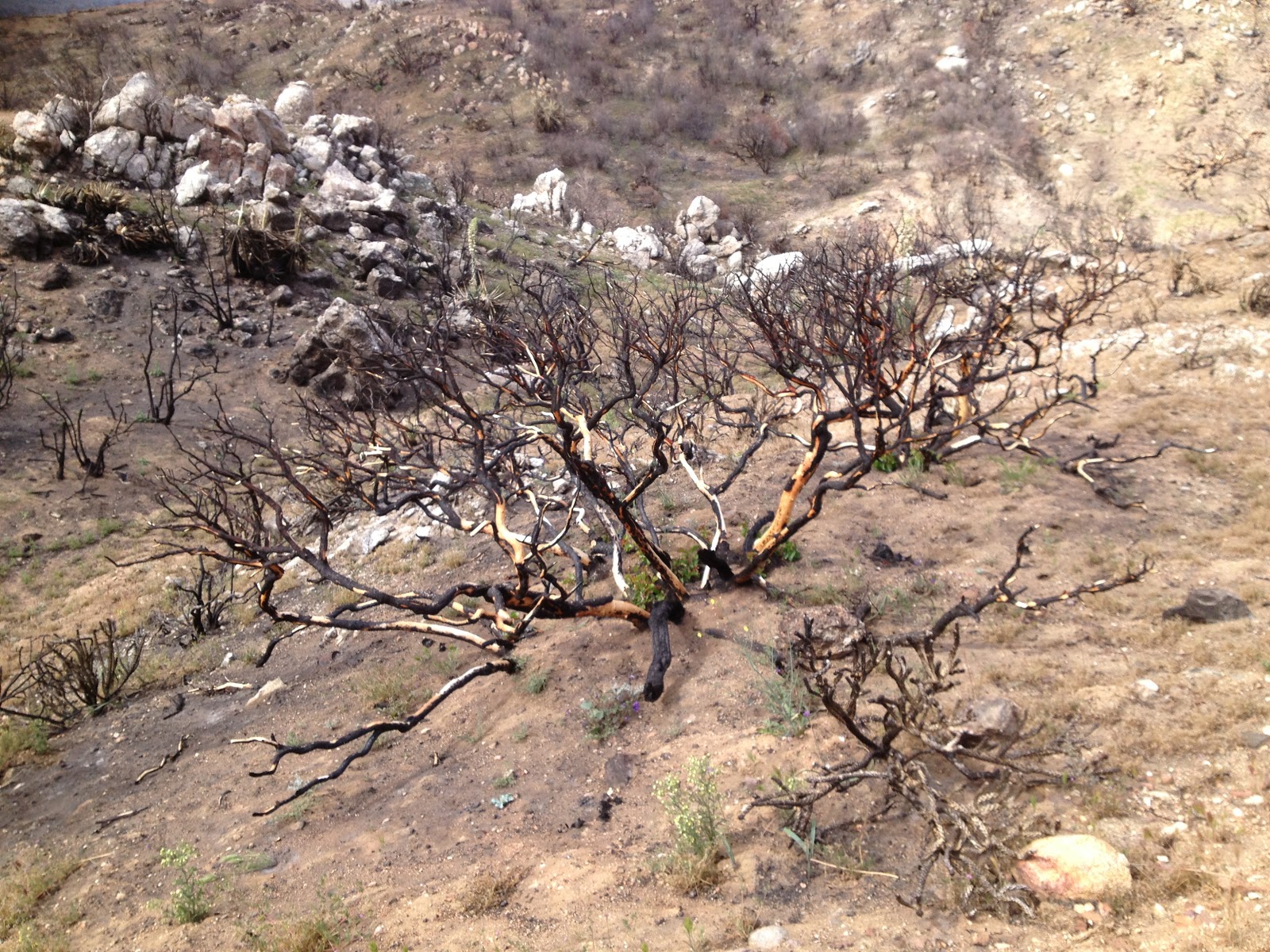
This section of the trail burned recently; for long stretches of it much of the flora is charred like this.

Some other hikers had caught up with us and at one point we were all together at a water cache.  Bruno was a young Frenchman who had been hiking in New Zealand before coming to the U.S.; he’d found out about the PCT on the plane ride here and had decided to hike it before landing.  He was small and wiry and hiked at least 30 miles a day.  I made a snack of sharp cheddar wrapped in a tortilla, and he looked down at it in disgust.

“In Fronce, we have none of zees – owange cheese.”  


Bruno taking a break at a cave to cook some Top Ramen

 In the afternoon I hiked a ridge so windy that I was actually afraid I might be blown off of it, and in the afternoon I discovered that breaks from hiking were more effective if I elevated my legs.  Afghani caught up with me and joined me, and we lay on the trail, our legs sticking up the hill and our heads pointing over the ledge, looking up at our feet and telling jokes.   

The 100-mile mark!

Afghani Danny having finished his 100 miles


 We hiked together into the Barrel Springs campground where Kobe was waiting for us with news of the Boston Marathon bombing.  I felt more angry than I did on September 11th, thinking ‘who the hell blows the legs off of people who derive joy from running?’  It just seemed so utterly senseless – is the Boston Marathon a symbol of anything other than personal athletic achievement?  It was too much, and I pushed it out of my head and returned to the world of pitching tents and treating water and cooking on camp stoves. 

Kobe wanted to reach Warner Springs that evening, but I didn’t have another 8 miles in me and Afghani had completed his 100 miles and was heading off of the PCT at Barrel Springs.  We tried to convince Kobe to stay, but he was determined to push on so we took photos and said goodbyes.  

Saying goodbye to the boys

Kobe is sad to leave.

Our campsite at Barrel Springs

I was worn out from the two days and it was still cold and windy, we chatted for awhile through the walls of our tents but I soon fell asleep.  In the morning we hugged walked out to Afghani’s departure point, hugged and promised to keep in touch, and I set off for Warner Springs.  I walked through open fields sprinkled with scurrying ground squirrels, and welcomed the change of scenery.


My first livestock sighting on the trail

Julian, April 13th-14th


I walked up to the fork at Scissors Crossing, stashed my pee rag[i] in the front pocket of my backpack, and stuck out my thumb.  Maybe 10 cars passed me before one stopped, a small sedan driven by a man in his forties.
 
“Are you going into Julian?”

“I guess I am now!”

Unsure, I stuffed my huge backpack onto my lap in the front seat and didn’t fasten my seatbelt in case I needed to get out in a hurry, but my apprehension didn’t last long.  Wes lived with his wife in another state and did maintenance for the railroad; he was in California on a project and was driving around to sightsee on his day off.  I told him about living in the former Soviet Union where the necessary investments in infrastructure had been made to make passenger rail a common method of transportation, and together we lamented the fact that his had not been done in the U.S.  

Wes dropped me at the post office where I was just in time to collect my package before they closed.  I was starting to realize that I’d mailed myself a lot of things that I didn’t need.  My biggest waste of money was a container of JetBoil fuel at each stop:  $5 for the fuel, $2 for the small cardboard box, and $3.50 for the shipping; it must be shipped separately from your other resupply items shipped priority mail because it’s a compressed mixture of isobutane and propane and must be labeled 

Surface Mail Only
Consumer Commodity ORM-D

Without this label, I think it’s a felony – with it, perfectly legal.  However, my JetBoil stove burned so hot that I could basically only boil water to make instant food (a few disastrous early attempts to cook in it necessitated brillo pads to remove the charred black layers of food from the pot) and it was efficient enough that it didn’t use much gas to do that, so I found myself at my resupply drops collecting canister after canister of expensive, unneeded fuel. 

Julian was a sort of faux-frontier town, tiny but full of tourists, western-themed souvenir shops, and restaurants.  There was a large motorcycle group apparently on a day trip, a few horse-drawn carriages offering rides, and a llama that could be posed with for pictures.  There was also a building advertising old-time reenactments and I would later see some of the performers having lunch in full costume, but I failed to catch a show.  I made my way to a barbecue joint and had lunch while chatting with the friendly woman at the counter; she offered to secure me a ride out to the nearest campground outside of town but I was too enthralled with the town and the prospect of going to a bar that night.   

My first restaurant meal since starting the trail - a pulled pork sandwich, macaroni salad, and coleslaw
 The town was unusually busy, due apparently to the fact that it was the “Taste of Julian” weekend, but the manager at the Hotel Julian agreed to drop the price of her last room from $125 to $95 as a hiker special and to do my laundry.  I really couldn’t afford it, but I have to admit that it was money well spent[ii].  The rooms were beautiful, with old-fashioned décor and modern bathrooms and no TV sets, and at 5:00 PM they served “high tea” where I ate enough scones, whipped cream, and jam to suffice for dinner and the local historian dropped by on his way home from work to give us a short lecture on the history of the hotel. 

David Lewis in the parlor of the Hotel Julian

David Lewis’ great-grandfather homesteaded in Julian, but it wasn’t until his cousin was killed by a drunk driver that his interest in local history was sparked.  Digging his cousin’s grave in the local cemetery and seeing the old tombstones opened that door, and he has since spent years learning all he can about the history of the place that is his home.  David’s most endearing quality is his open admission of what he does not know, and how what is taken for truth changes as new information is uncovered.  He likes to say, “What I’m telling you today may not be true tomorrow.” 
 
The Hotel Julian is special because it was built and opened by freed slaves Albert and Margaret Robinson.  There is record of Albert Robinson and a Union cavalryman by the name of Chase taking a steamship to San Diego together from New York; Chase would become a prominent lawyer in El Cajon and Chase Avenue there is named after him.  Margaret was from Temeculah, the record suggests that her first husband John Boyd was absent and that she was a single mother before marrying Albert.  The homestead act of 1862 enabled them to homestead in Julian, and they first built a bakery/restaurant and ran that for 10 years before building the hotel.  It’s unclear whether they had help financing the construction of the hotel, but David points out that it was a bold business venture given the fact that there were already two hotels in town owned by whites, and speculates that the lawyer Boyd may have helped his friend Albert.  Albert died in Julian but Margaret simply disappeared from the historical record and David has yet to uncover the end of her story.  He’s even written Oprah for help, but he has yet to hear back.  

Margaret and Albert Robinson

The original hotel as it was called then - Hotel Robinson

 In the evening I walked to the local restaurant/bar where there was a band playing.  Outside of the building I recognized a group of Brits from the hotel, and stopped to talk to them.  They had just kicked off their own 2,600 mile trip from California to Florida.  Joy was driving a car from 1904, and the rest of the crew was her support staff – a co-pilot, mechanics, a filmmaking crew, etc.  I spoke with her and she told me that she had planned to make the trip with her partner, but he had died of cancer in 2010.  Instead she was making the trip in his memory, and raising money research into the mechanisms via which cancer spreads throughout the body.  The next day I would catch the group on their way out of the hotel, and snap photos of them as they left the hotel, caravanning with a local couple who owned a car made in 1901 and had decided to join them for a the day.  


I would later visit the project’s website (http://joy-across-america.com/) and be amazed at the pictures of Joy’s career as a race car driver (http://joy-across-america.com/the-driver/).

I spent an uneventful evening listening to a Pink Floyd cover band, drinking locally brewed beer, and developing the concomitant headache that comes with miles of hiking in the heat followed by beer.   


 In the morning the hotel served cheesy polenta topped with poached eggs and hollandaise sauce, and I sat with the hotel’s only other hiker, Mike.  Mike was retired and was doing the hike in two-month sections.  He would do the first two months northbound, then go home for two months and then do the Sierras southbound, and then return next year to complete the final stretch in the north.  This was because his wife did not want to be abandoned while he went hiking, and they had compromised on two-month absences.  We chatted about campstoves and blogging, and he told me that his own blog was at www.postholer.com/miked, and I cracked up.  

“Mike D?  Like the Beastie Boy?”  His face was blank.  “My name’s Mike D, and I get respect – your cash and your jewelry are what I expect!”  He stared at me, perplexed.  I would later see him on the trail and he would tell me that he had been given the trail name of “Evergreen,” but I’ll never call him anything other than “Mike D.”  


Mike D

We ran into each other again at lunch, where I was wolfing down a hamburger and a huge milkshake, while Tim McGraw sang 

I’m just a singer of simple songs
I’m not a real political man
I watch CNN, but I don’t think I could tell you
The difference ‘tween Iraq and Iran.

“Why is it,” I demanded, “that the United States is the only country that celebrates ignorance?”  Mike D nodded, and I continued, “I mean, they’re not even related – Iraqis are Arabs, they speak Arabic – Iranians are Persians, they’re Indo-European, their language is in the same family as ours.  They’re nothing alike!”  Mike D agreed, and we walked down the street towards the hotel.  A blind man played the guitar on the street and I dropped my change into his can to drop the weight from my pack.  He thanked me, introduced himself as Dave, and asked me what I wanted to hear.  

Dave

 He knew the chords for Long Black Veil but was fuzzy on the lyrics, so I sat down with him.  I would start each line and then he would remember the words and come in over me, his voice stronger and richer.  

Ten years ago on a cold dark night
Someone was killed beneath the town hall light
There were few at the scene, but they all did agree
That the slayer who ran looked a lot like me
She walks these hills in a long black veil
She visits my grave when the night winds wail
Nobody knows, nobody sees, nobody knows but me

The judge said “son, what is your alibi?
If you were somewhere else, then you won’t have to die.”
I said not a word, though it meant my life,
For I had been in the arms of my best friend's wife.
Oh, she walks these hills in a long black veil.
She visits my grave when the night winds wail.
Nobody knows, nobody sees, nobody knows but me.

The scaffold was high, and eternity near
She stood in the crowd and she shed not a tear
But sometimes at night when the cold winds blow
In a long black veil she cries over my bones.
She walks these hills in a long black veil
She visits my grave when the night winds wail
Nobody knows, nobody sees, nobody knows but me.

Oh, she walks these hills in a long black veil
She visits my grave when the night winds wail
Nobody knows, nobody sees, nobody knows but me.


 A small crowd gathered.  Dave and I chatted about getting to the point in your life where you’re old enough to want to live outside of the city, and then he played and we sang a little more before I moved on to head back to the trail.  

On the way out of town I was picked up by a young couple in a Volkswagen Van.  Joaquin and Anna were from Argentina, and they had an apartment that they got $600/month rent from, and they were living off of that and touring the Americas.  They said that they had stopped and worked a little in other countries when they needed money, but that the U.S. wasn’t expensive.  Interior components of the van folded out into a bed, and they basically only needed to buy food and fuel.  Their goal was Alaska.

“Wow, that’s great,” I said, “How long have you been on your trip?”

“Two years,” replied Anna, matter-of-factly.  I was deeply impressed.  I asked if they were blogging and she said yes and gave me the address, http://poramericaandando.blogspot.com/.  She warned me that it was all in Spanish, and I told her that I would make my sister and brother-in-law read it to me.  I knew that I’d meet other PCT  hikers, but in less than a week of hiking I’d met Derek on his cross-country bike tour, Joy on her cross-country motorcar tour, and Anna and Joaquin on their inter-Americas bus tour.  If I had met that many in such a short time, there must be an awful lot of people out there just exploring the world in their own way.   

Anna and Joaquin (you can't really see Joaquin, but he's in the van.)


[i] Burying toilet paper ten times a day would be too much, so women are generally advised to carry a bandanna for this purpose.  It hangs on the outside of your pack and dries out in between uses, but it’s obviously better to stow it before getting in someone’s car. 
[ii] They not only washed my clothes, but after they gave them back to me I changed and gave them the clothes I had been wearing while they washed the others, and they washed those too, which was pretty awesome.  Before agreeing to take the room I had walked over to the town’s other hotel where the manager had told me that they it wasn’t possible to do laundry there (how do they wash the sheets?), so between that service and the generous amount of complimentary food I would recommend the Hotel Julian to any hiker.